The Conversational State Transition Model
A neurocognitive model of how conversation changes what becomes thinkable and actionable
Read the paper
White paper / 03 / Piloteer Labs research
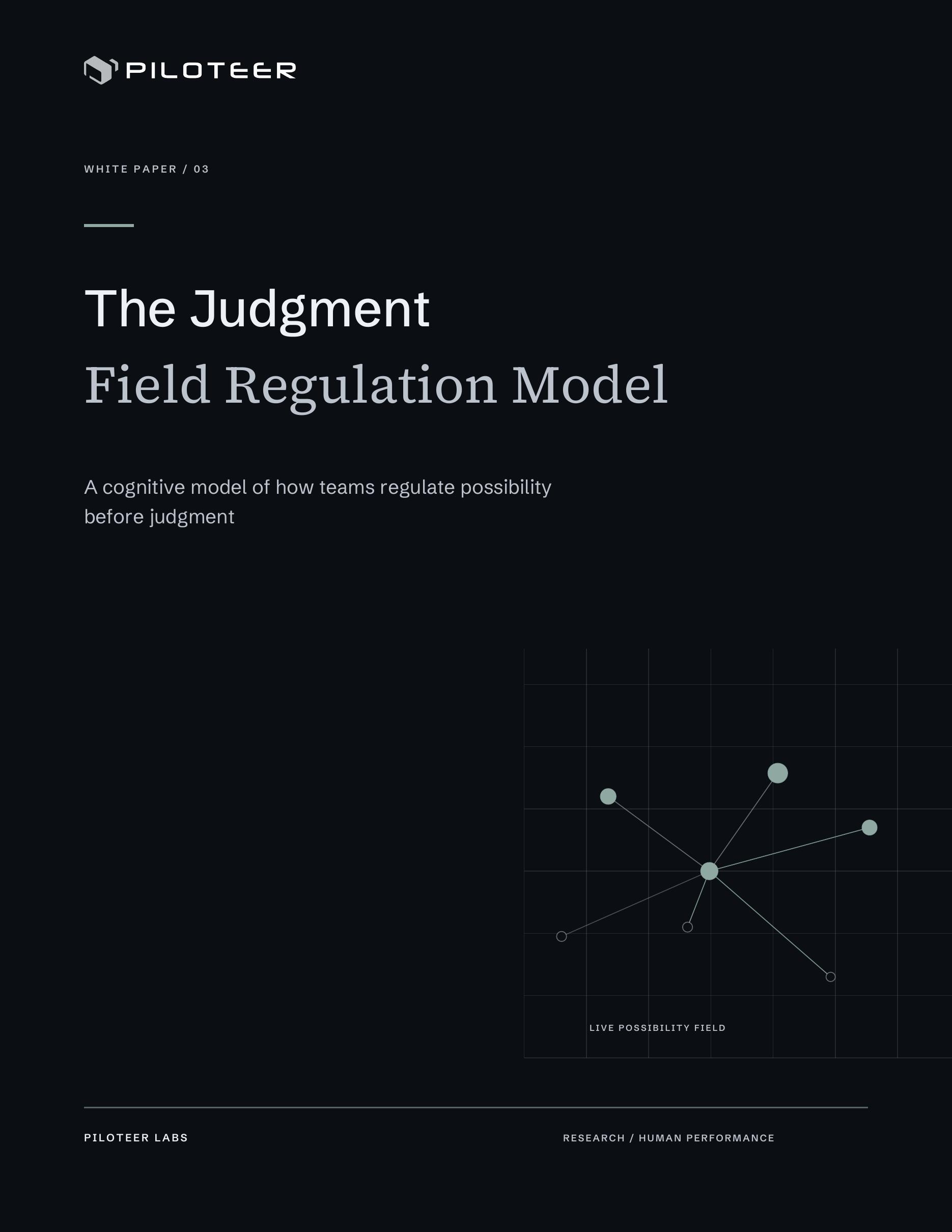
A cognitive model of how teams regulate possibility before judgment
Inside the model
A team can debate the wrong question brilliantly. JFRM examines the live field of possibilities that must be present, compared, and regulated before a decision can be any good.
An absent contender cannot lose. If a possibility never becomes live in the room, it cannot be tested or chosen.
What is present is not the same as what is live. Strength, breadth, functional dispersion, and persistence describe the field that is actually pressing on judgment.
More possibilities are not always better. Effective judgment widens under uncertainty, compresses as evidence concentrates, and reopens when expectation fails.
The same bad decision can come from premature compression, false breadth, dominant frame lock, failed reopening, or unproductive expansion.
A team can know everything and still consider too little. Silence is not evidence of absence. Mention is not evidence of influence.
Judgment intelligence is the capacity to regulate the field of live possibilities so its shape remains appropriate to uncertainty, evidence, and change.
How to read this
See it in the work
Start with the paper. Then look at how Piloteer turns live interaction into evidence leaders can act on while the work is still moving.