The Conversational State Transition Model
A neurocognitive model of how conversation changes what becomes thinkable and actionable
Read the paper
White paper / 02 / Piloteer Labs research
A neurocognitive model of how conversation changes what becomes thinkable and actionable
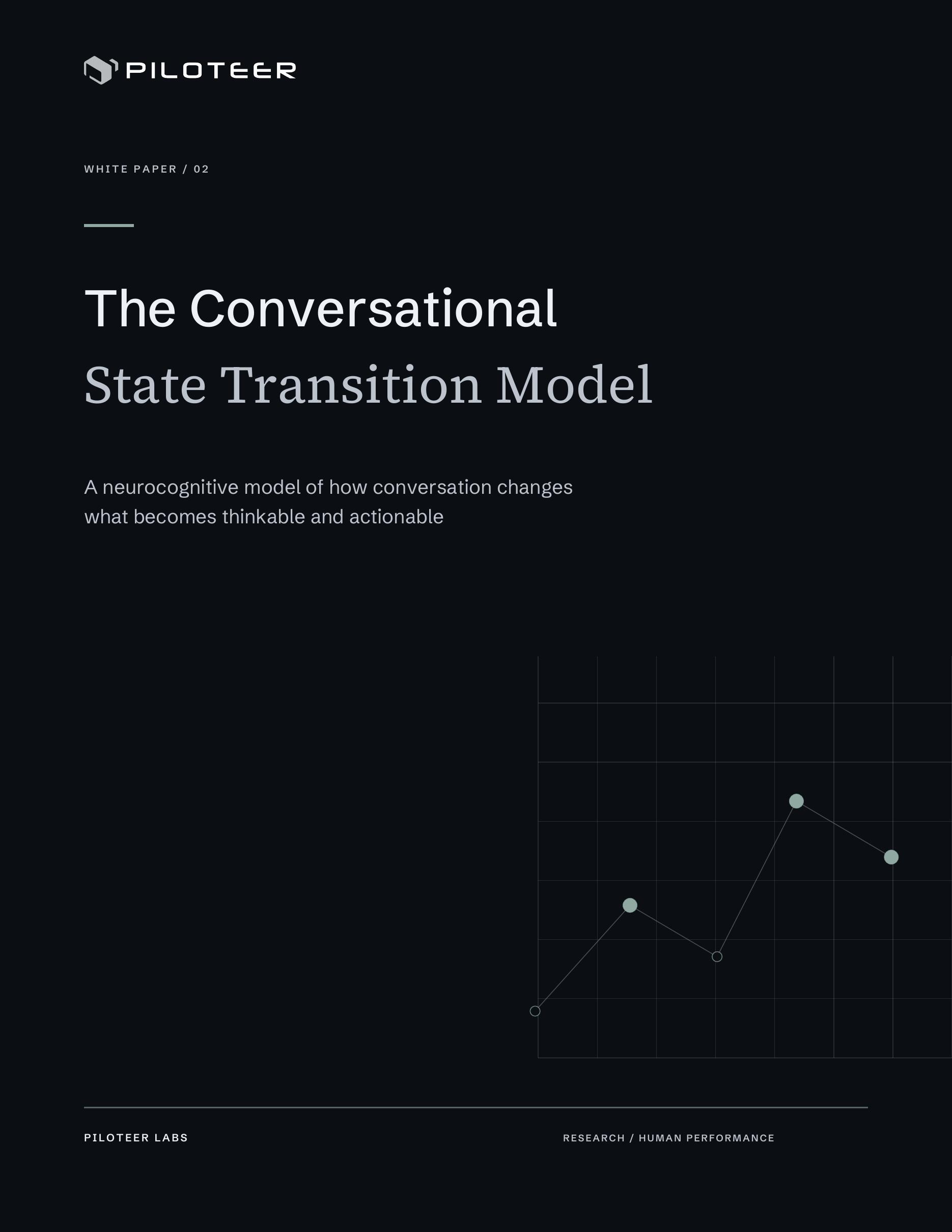
Inside the model
Conversation is usually treated as information exchange. CSTM treats it as an external control process that changes which cognitive states become reachable next.
The information was often already present. What changed was the reachable cognitive state: which thoughts, connections, and next moves became available.
Relational maps, prediction and updating, cognitive control, and interpersonal alignment already provide machinery for conversation to change what becomes thinkable.
The object of measurement is not the utterance itself. It is the transition from the current state, through an intervention, into the next state.
Question, analogy, contradiction, reframe, and summary are different acts with one higher-order function: they alter cognitive reachability.
Surface behavior can look excellent and still produce little state change. A single intervention can reorganize the trajectory of everything that follows.
Conversational intelligence is the capacity to produce interventions that move a mind, or a group of minds, toward states from which better judgment and action become reachable.
How to read this
See it in the work
Start with the paper. Then look at how Piloteer turns live interaction into evidence leaders can act on while the work is still moving.